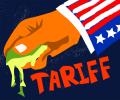
A bipartisan group of US senators has introduced a comprehensive bill imposing extensive sanctions on Russia, with India identified as one of five countries that could incur tariffs for its continued purchase of Russian oil.

One should not expect the blue wave to reverse some of Mr Trump's hostile measures against India on immigration and on trade. The Democrats are unlikely to ease the limits placed on the entry of Indian professionals into the US. They are equally unlikely to ease up on Mr Trump's protectionist policies cautions former foreign secretary Shyam Saran.

India's Indo-Pacific approach has traditionally emphasised strategic autonomy, ASEAN centrality, freedom of navigation, respect for international law and an inclusive regional order. Its growing defence and maritime partnerships with Australia, Japan, Indonesia, Vietnam and other Southeast Asian countries provide additional depth to this approach, point out Dr Kumar and Dr Jasmeet Kaur.

The US Senate has overwhelmingly approved a bill, the Lindsey O. Graham Sanctioning Russia and Iran Act of 2026, which aims to punish Russia and its major petroleum product buyers, including China and India. The legislation allows the US President to impose 100 per cent tariffs on goods from the top five importers of Russian oil and gas, and also extends sanctions on Iran's energy sector. The bill, championed by the late Senator Lindsey Graham, now moves to the House of Representatives for further approval.

A bipartisan group of US Senators has agreed to fast-track a bill allowing the President to impose sanctions on major purchasers of oil from Russia and Iran. This legislation, known as the Lindsey O. Graham Sanctioning Russia and Iran Act of 2026, aims to restrict funding for Russia's war efforts and Iran's energy and weapons sectors, potentially impacting countries like China and India through tariffs and other restrictions.

Indian-Americans have achieved significant victories in state legislative races across the US midterm elections, with several individuals securing key positions and making history in various states like Michigan, Arizona, Illinois, and Texas, further solidifying their growing political influence.

Former US Secretary of State Antony Blinken stated that the US must respect India's right to self-defence and maintain a zero-tolerance policy towards terrorism, highlighting the "fundamentally different" nature of Washington's relationships with New Delhi and Islamabad. He described US-India ties as global and strategic, while US-Pakistan relations are regional. Blinken also touched upon cooperation in emerging technologies, India's ties with Russia, rapid global changes, US domestic politics, and the West Asia conflict, advocating for a two-state solution.

Americans are voting in crucial midterm elections, widely seen as a referendum on Donald Trump's presidency. The elections will determine control of the House and Senate, with Democrats hoping to gain power. Key races include governorships and numerous Indian-American candidates. Trump's last-minute policy announcements and campaigning efforts are highlighted, as analysts predict a potential shift in power that could limit his agenda.
The bill, introduced on Thursday, was conceived by Democrat Senator Richard Blumenthal and late Republican Senator Lindsey Graham and has the support of over 60 lawmakers.

Indian-American Democratic lawmakers Ami Bera, Ro Khanna, Suhas Subramanyam, and Pramila Jayapal have been re-elected to the US House of Representatives, with Pia Dandiya making her debut, marking a strong showing by the community in the recent midterm elections where Democrats gained control of both the House and Senate.
The Samosa Caucus, an informal group of Indian-American lawmakers, is set to expand its presence in the US House of Representatives following the recent elections. With Democrats gaining control of both the House and Senate, re-elected members like Ami Bera, Ro Khanna, Suhas Subramanyam, and Pramila Jayapal will be joined by newcomers Pia Dandiya and Amish Shah, significantly increasing Indian-American representation on Capitol Hill.
Analysts predict that the US midterm election results, which saw Democrats gain control of Congress, will primarily influence Indian markets through changes in global financial conditions, trade policy expectations, and geopolitical developments, with a keen focus on the US administration's actions in West Asia and their potential impact on crude oil prices.

Social media erupted with memes and witty one-liners featuring Chief Election Commissioner Gyanesh Kumar following Donald Trump's Republican Party's significant losses in the US mid-term polls. These memes humorously suggested Kumar's intervention could have prevented Trump's defeat, drawing parallels to an ongoing "vote chori" controversy in India. The widespread losses for Trump's party were attributed to public anger over his policies.

Indian benchmark indices Sensex and Nifty surged significantly in early trade, driven by a sharp decline in crude oil prices and optimism surrounding a potential resolution to the West Asia conflict following the US midterm elections, which saw the Democratic Party gain control of Congress. Track Sensex, Nifty on November 5, 2026.
Indian benchmark indices, the Sensex and Nifty, witnessed a significant rally, with the Sensex jumping 2,009 points and the Nifty surging 576 points. This surge is attributed to a sharp decline in crude oil prices, hopes for a resolution to the West Asia conflict, and the Democratic Party gaining control of the US Congress in the midterm elections.

US Vice President JD Vance and Prime Minister Narendra Modi held a phone call to discuss expanding the India-US comprehensive global strategic partnership, focusing on trade, defence, energy security, emerging technologies, and critical minerals. The discussion comes amidst rising tensions in West Asia and recent regional realignments, with both leaders reaffirming their commitment to strengthening cooperation.

US President Donald Trump has defended a controversial diesel deal with Russia, stating it aims to stabilise the global market despite bipartisan criticism from US lawmakers. The deal, which eases sanctions on Russian diesel shipments until April 2027, has been criticised as a "gift to our adversary" that finances Russia's war efforts and offers little relief to Americans.

The US House of Representatives has passed the Lindsey O Graham Sanctioning Russia and Iran Act of 2026, authorising President Trump to impose sanctions on Russia's energy sector and tariffs on countries like India and China that purchase Russian oil and gas. The legislation aims to curb Russia's ability to evade existing sanctions and reduce global dependence on its energy exports, despite some Democratic opposition to increased tariff authority for the President.

The US announced a 60-day pause on sanctions against Russia and tariffs on other countries, including India, to analyse the global economic impact. This decision, made via an executive order by Trump, has drawn significant criticism from both Republicans and Democrats, who had previously passed the Lindsey O. Graham Sanctioning Russia and Iran Act. US officials stated the waiver allows for assessment of global energy pressures and European allies' refusal to impose secondary sanctions on Russian oil buyers.

The US House of Representatives has advanced a bill that would empower President Donald Trump to impose 100 per cent tariffs on countries, including India, that purchase oil and gas from Russia, and also extend sanctions on Iran. The legislation, which previously passed the Senate, aims to curb Russia's energy revenue amidst the Ukraine conflict.

The US midterm elections saw the Democratic Party gain control of Congress and key gubernatorial posts, leading international affairs experts to view the outcome as a referendum on President Donald Trump's policies. Analysts suggest the results signal a desire for change in his behaviour and could prompt a more pragmatic approach in his remaining term, with potential implications for global politics and India-US relations.

'Trump has weakened, not necessarily restrained.'

Saba Haider, an Indian-origin Democrat elected to the Illinois General Assembly, believes her victory signifies a shift in US voter priorities towards everyday concerns like affordability, healthcare, education, and environment, moving away from divisive politics. She highlighted the challenges of campaigning and the scrutiny faced by women in politics, while also encouraging young South Asian Americans to engage in local campaigns.

Shuchita Patel, an Indian-American Democrat, is making a historic bid for Forsyth County Commissioner in Georgia, a region with a dark racial past. Running against a 16-year unopposed incumbent, Patel aims to bring change and stand up to what she calls a "bully" opponent, driven by a desire to create a better community for future generations amidst a deeply divided American political landscape.

The US House of Representatives is debating a bill that would authorise the President to impose sanctions on Russia and steep tariffs on its oil and gas trading partners, including India and China. The bill, aimed at pressuring Russia over the Ukraine war, has faced opposition but is expected to be put to a vote.

Several Indian-Americans have achieved significant victories in the US midterm elections, with five securing seats in the House of Representatives and Maryland Lieutenant Governor Aruna Miller winning re-election. The article profiles these successful candidates, highlighting their backgrounds and contributions to American politics.

US lawmakers are racing to amend the Russia sanctions bill before recess. One amendment specifically names India, China, and other countries as potential targets for 100% tariffs due to their oil trade with Russia. Another significant amendment proposes to scrap the tariff section entirely, while others address presidential waiver powers and aid to Ukraine.

President Donald Trump is set to sign the Sanctioning Russia and Iran Act, which includes tariffs on countries buying Russian oil and gas, such as India. India has voiced concerns over the potential impact on its ties with the US and the global energy market.

US President Donald Trump is expected to sign the Lindsey O. Graham Sanctioning Russia and Iran Act of 2026 later on Friday (local time). A White House official confirmed the development to ANI without revealing further details.

The Bill proposes replacing employment-based Green Card preferences with a points-based immigration framework.

India has stated its commitment to protecting its economic interests and ensuring energy security after the US House of Representatives passed a bill allowing the US President to impose tariffs of up to 100 per cent on countries, including India and China, for purchasing Russian crude oil. The Ministry of External Affairs affirmed India's resolve to maintain diversified energy sourcing and has articulated its concerns to US interlocutors regarding the bill's potential implications.

'If you listen to a rowdy in a class, he will keep on bullying you.' 'India can say do whatever you want. We will not compromise on anything.'
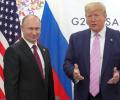
Former President Donald Trump's recent deal with Russia to supply diesel to the US and global markets has ignited a political firestorm, drawing sharp criticism from Ukraine's President Volodymyr Zelenskyy, Democratic leaders, and a segment of Republicans, despite the US Treasury lifting sanctions on Russian diesel supplies.

The US senate last week passed a bill that would allow Washington to impose tariffs on major buyers of Russian energy.

The US push for clearer crypto rules is putting pressure on India to fill its own regulatory gap for virtual digital assets.
It is plain to see that the US senate bill's real objective is to derail India's time-tested strategic partnership with Russia, points out Ambassador M K Bhadrakumar.

US Republican Senator Lindsey Graham, a prominent ally of former President Donald Trump and an influential voice on American foreign policy, has passed away at 71 following a 'brief and sudden illness', leaving a significant void in Washington's political landscape.

Indian-American Congressman Raja Krishnamoorthi voted in favour of a Russia sanctions act in the US House, diverging from his Democratic party and other Indian-American lawmakers. The bill, which passed, imposes tariffs on Russian oil and gas buyers, potentially impacting India and China, and exempts US uranium purchases from Russia.

'It beggars belief that Saudi Arabia would deploy military force against India, a top partner and market.'

China has strongly rejected a US bill that would impose tariffs on countries, including India, for purchasing Russian oil and gas. Beijing views the "Lindsey O Graham Sanctioning Russia and Iran Act 2026" as an act of "long-arm jurisdiction" and interference in its sovereign trade relations, asserting that its economic cooperation with other nations is based on equality and mutual benefit.
